Information
Scoliosis is an abnormal curvature of the spine that causes it to deviate from its normal straight vertical line and
form a C or S shape.
Types of Scoliosis
Idiopathic Scoliosis
Idiopathic Scoliosis is the most common type of scoliosis and accounts for roughly 80% of all cases. However, although there is no definite known cause, having a genetic link to someone in your family who had scoliosis increase your chances of having it too. Depending on the age you are diagnosed, you may have a different name for your scoliosis:
Congenital Scoliosis
Congenital Scoliosis is a rare type that develops in the womb when vertebrae fail to form a normal spine structure.
Neuromuscular Scoliosis
Neuromuscular Scoliosis is caused by nerve or muscle conditions that prevent the spine from supporting itself and is
often diagnosed alongside conditions such as cerebral palsy.
Degenerative Scoliosis
Degenerative Scoliosis is developed by adults later in life due to degeneration and wear in one's bones, which results
in the spine collapsing or bending.
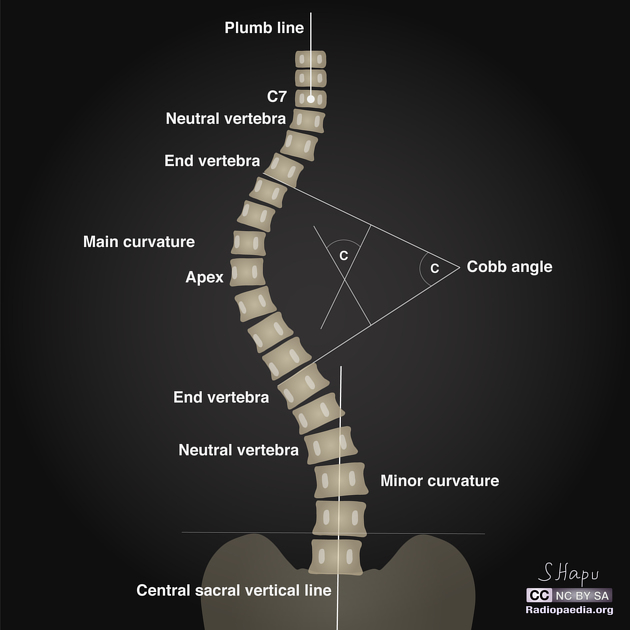
Cobb Angle
The severity of one's scoliosis can be measured by doctors using a universal standard that is calculated from an X-ray and measures the angle between the most tilted vertebrae at the top and bottom of the curve.
Scoliosis Treatments
Depending on the severity of your curve and the amount of growth you have left, you may receive different options for treatment.
Curves under 20 degrees
For people who are no longer growing, you may not need any treatment for your scoliosis.
For children who have not yet finished growing, doctors will typically recommend having regular checkups and X-rays
taken every 6-12 months to monitor the curve and identify the rate it is progressing.
Curves larger than 20 degrees but under 45 degrees
A moderate curve from 25-45 degrees can be stopped from progressing, but not necessarily straightened.
Corrective bracing like a TLSO or Boston brace can be used for growing children. These braces apply pressure to slow the
curve's progression. Physical therapy such as scoliosis exercises including the Schroth Method can strengthen your muscles and in turn
stabilize the spine while improving posture and relieving back pain.
Curves over 45 degrees
Surgery may be recommended for severe curves over 50 degrees or extremely painful curves, especially those that affect
your heart and lungs.
There are 2 main surgeries that correct scoliosis curves.
Spinal Fusion
This surgery attaches rods and screws to the curve that essentially fuses the child's spine to straighten the curve. As
spinal fusion "fuses" the bones together, it decreases one's flexibility as their ability to bend along the fused area will
be limited. However, this surgery is the most common and has the highest rates of success.
VBT (Vertebral Body Tethering)
Instead of fusing the spine, the VBT System plants "The Tether", a flexible cord that is attached to the spine. Although
this surgery allows the patient to bend and retain flexibility, it requires the patient to have a considerable amount of
growth left.
In particular, as the patient grows, the cord will put pressure on the outside of the curve to straighten the spine.
Although I will not describe these treatments in detail here, you can look into Halo Traction and Anterior Scoliosis
Correction (ASC) for correcting severe curves. However, these treatments are relatively new and only available in
specific countries.
The main source I used for this information was https://www.shrinerschildrens.org/en/pediatric-care/scoliosis.